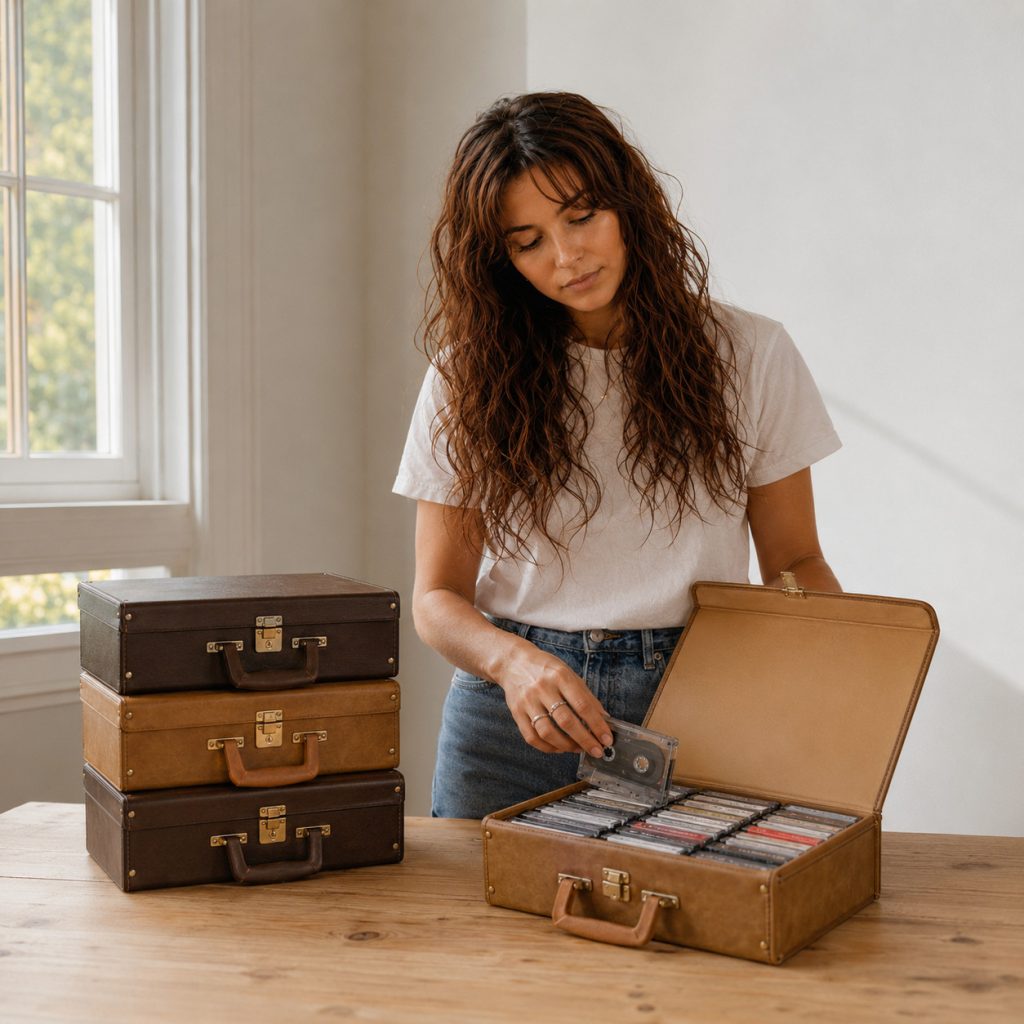
For a long time, the songs lived in boxes.
That is a strange sentence, but it is true.
After the recording years faded, after Dallas, after Dusty Brown, and after the Roland studio was gone, the music did not disappear. Some of it had been captured. Some of it had survived on cassette tapes, DAT tapes, notebooks, typed lyrics, fragments, and memories.
But surviving is not the same as living.
The songs were there, but they were not moving. They were not being heard. They were not being worked on. They were not being finished. They were more like old letters from another version of myself.
Every now and then, I knew they existed. I knew there were recordings somewhere. I knew there were songs from the old days. I knew there were pieces of my music life sitting quietly in the past.
But most of the time, life moved forward without them.
I had three cassette boxes. They were about a foot and a half by a foot. I do not know how many tapes each one held, but I think each one held about fifty. Those boxes had a lot of my old recordings in them.
Some were from the original recordings I did when I was young, using the four-track in Lloyd Clayton Bowen’s bedroom. Some were from other four-track recorders I had used through the years. Some were from seminary. Some were from bands and jam sessions. The digital recordings from Dusty Brown were on DAT tapes, which were in a different box.
Then the pandemic came.
The world slowed down in a way none of us expected. Everything changed. Normal rhythms were interrupted. People were suddenly inside more. Old things came back into view.
For me, one of the things that came back was the old music.
The pandemic really gave me the time, and probably pushed me into the mood, to open those old boxes and start looking through them.
I cannot say for sure that the first time I digitized my four-track recordings was during the pandemic, but the pandemic gave me time to do a lot of it.
Cassettes are fragile things. They do not feel fragile when you are young and using them every day. Back then, a cassette was normal. You recorded on it, labeled it, played it back, carried it around, copied it, rewound it, fast-forwarded it, and threw it into a drawer.
But decades later, a cassette feels like a rescued artifact.
The plastic shell is still there. The little screws are still there. The tape is still wound inside. The label may have faded. The handwriting may be old. The sound may still exist, but you do not know what condition it is in until you try to play it.
There is a little fear in that.
What if the tape breaks?
What if the sound is ruined?
What if the recording is not what I remember?
What if it is worse?
What if the song I carried in memory does not survive the listening?
That is part of the danger of returning to old work. Memory is merciful. Tape is not. Memory preserves the feeling. Tape preserves the reality. And the reality can be rough.
But I wanted to hear them.
By then, we had the ability to plug a cable into a cassette player, plug it into a computer, and use a digital audio workstation. We could add effects, take out tape hiss, and make the recordings better.
So during the pandemic, I digitized quite a few of my songs. I do not know exactly how many, but it might have been around a hundred.
I decided to do only the best ones.
Even a lot of those would not make it into the new system later. But the digitized recordings allowed me to have maybe a hundred songs on my phone that I could listen to.
That was a big project.
I bought some pretty expensive software to make them as good as I could possibly make them. I reduced hiss where I could. I transferred things into digital form. I tried to preserve what could be preserved.
Some songs sounded better than I expected.
Some sounded worse.
Some had tape hiss so loud it felt like the song was buried under weather. Some had uneven levels. Some had weak vocals. Some had guitar mistakes. Some had the strange thinness that old home recordings often have. Some were almost painful to listen to because I could hear what I had wanted them to be, and I could also hear how far away they were from that.
But underneath all of that, the songs were still there.
That surprised me.
The recordings were rough, but the songs had not died.
That was important.
Because when you have left music alone for many years, you begin to wonder if it was ever really what you thought it was. Maybe the songs mattered only because you were young. Maybe the emotion seemed powerful only because it belonged to that season. Maybe the music was not really strong. Maybe it was just memory making it larger.
But then I listened again.
And I heard songs.
Not finished records.
Not polished productions.
Not something ready for the world.
But songs.
Real songs.
That gave me a strange mixture of grief and hope.
The grief came because I could hear all the years that had passed. I could hear the lost opportunity. I could hear the equipment I no longer had. I could hear the young voice. I could hear the unfinished work. I could hear the distance between what the songs were and what they might have become.
But the hope came because they had survived.
They were still there.
The melodies still carried something. The chord changes still moved me. The emotional center was still alive. The younger version of me had not been completely wrong. There really had been something in those songs.
I had all my songs numbered. That is another thing I did over the years. I tried to organize everything and keep it in this notebook that had all of my songs in it, along with the sheets where I had written the lyrics.
I had to get all of the lyrics into text format too.
So during that time, I was not only digitizing the tapes. I was organizing lyrics. I was gathering songs. I was trying to make sense of what I had actually written and recorded over the years.
After I digitized the songs, I decided to get into Spotify and see what that was all about.
So I uploaded the album of my digital recordings to Spotify. Listen to the Dusty Brown album on Spotify. Listen to Dusty Brown on iTunes. Get the book Dusty Brown on Amazon.
I have one monthly listener.
And thank God for him or her. I hope he is really enjoying Dusty Brown, because it took a lot of work to make that album.
I also organized everything into albums. I started putting album covers on them and putting the songs in an order that kind of flowed. I had four or five albums. I put some of the music on SoundCloud. I had a couple of other places where I put the music. I even had my own website, and I put the MP3s up there and passed them around to a few people.
There are only a couple of people who ever told me they listened to my music.
One was a friend of mine from a long time ago. I had given him cassettes long ago, and he really liked them. He said he still listened to them.
Another was a missionary training candidate who eventually went to Nepal. For some reason, he was interested in my music. So I gave him a thumb drive with all my MP3s on it. I hope he took it with him to Nepal. He speaks English, so maybe he can console himself in the Lord with it.
Still, there was a hard truth.
The demos were not really finished enough for other people.
That was painful to admit, but it was honest. I could listen to them because I knew what they were. I knew where they came from. I knew the emotion behind them. I knew the missing pieces. I could hear past the tape hiss and imagine what the song was supposed to be.
But an average listener would not hear them that way.
Most people would hear an old rough recording.
They would hear the flaws first.
They would not have the memory to fill in the gaps.
That is one of the hardest parts of old demos. To the songwriter, a demo can be sacred. To everyone else, it may just sound unfinished.
I had to face that.
These recordings were valuable, but they were not enough by themselves.
They were not the finished version of the songs.
They were evidence.
They were seeds.
They were maps.
They showed where the songs had been, but they did not yet show where the songs could go.
The software is used to restore all my analog tapes to digital audio was iZotope RX, Bandlab and Audacity.
At the time I was restoring my old four track recordings, I did not know what would solve that problem. I did not know that a door was about to open through technology. I did not know that AI music tools would arrive in a way that could take an old melody, an old lyric, an old emotional direction, and help build a new version around it.
I only knew that I had old songs, and I did not want them to vanish.
That was enough.
So the pandemic became a turning point.
Not because I suddenly had a new music career.
Not because the old demos were ready.
Not because everything became clear.
But because I started touching the old music again.
I started listening. I started preserving. I started organizing. I started remembering. And remembering is powerful.
When you return to old songs, you are not only hearing music. You are meeting yourself. You are meeting the young person who wrote those lines, who sang those melodies, who believed enough to press record. You are meeting the person who had not yet lived the next twenty-five years.
Those tapes caught me.
Years later, I was listening to myself from across time.
There was something humbling about that. I could hear immaturity in some places. I could hear lines that needed work. I could hear places where the song had not fully become itself. But I could also hear sincerity. I could hear longing. I could hear the emotional world that had always driven my music.
That mattered because sincerity is hard to fake.
A rough song with a real heart still has something.
A polished song with no heart does not.
The old cassettes reminded me that the most important thing was not polish.
The most important thing was the heart. Also all the practice of writing and arranging songs gave them life.
And the songs still had life.
I heard a university student say recently that she did not feel like continuing to take courses for music and develop her craft because AI music can do all that. She is wrong. Your craft is what enables AI to give you a good song. Garbage in, AI slop out. Good music in Better music out.
Read Why You Still Need to Develop Your Craft in the Age of AI Music
I did not know exactly what I was preparing for, but I was preparing. I was gathering the old pieces. I was putting the past into a form that could be used again. I was moving songs from fragile tape into digital space. I was turning old handwritten or scattered lyrics into organized text.
I was building an archive without fully knowing why.
That has happened more than once in my life. I have worked on things for years before understanding what they were for. At the time, it can feel like wasted effort. Later, it becomes obvious that the work was necessary.
Digitizing and restoring those tapes was necessary.
Typing those songs was necessary.
Cleaning up those recordings was necessary.
Facing the flaws was necessary.
Admitting the demos were not enough was necessary.
Because all of that prepared me for the next door.
Digitizing audio means transferring sound from an analog format, such as cassette tape, reel-to-reel tape, vinyl, or DAT, into a digital audio file on a computer, such as WAV, MP3, or FLAC. It is the process of capturing the original sound so it can be stored, edited, copied, and played digitally.
Restoring audio means cleaning and improving an old or damaged recording after it has been digitized. This can include reducing tape hiss, removing hum or clicks, improving volume levels, fixing harsh frequencies, balancing the sound, and making the recording clearer while trying to preserve the original performance.
The old recordings could not become the final answer, but they could become the foundation.
That’s the difference.
A foundation does not look like the finished house. It is rough. It is hidden. It is not the thing people admire when they walk in. But without it, the house cannot stand.
The old cassette recordings became the foundation.
They held the original melodies.
They held the original lyrics.
They held the timing, the phrasing, the chord changes, and the emotional DNA of the songs.
It is amazing that the AI can pick up on the energy of how you sing the songs and even the words you write.
They were not finished records, but they were living source material.
And that phrase matters: source material.
Because later, when AI music entered the story, I was not starting with nothing. I was not just typing random prompts into a machine and asking it to invent a life I had not lived.
I had songs.
I had recordings.
I had melodies.
I had decades of emotional history.
I had the original demos.
But before any of that could happen, the tapes had to come out of the boxes.
They had to be heard again.
They had to be saved.
Those boxes of old cassettes, full of tape hiss, memory, grief, love, gave a little more hope to preserve my music, and the first quiet sign that the music story was not over.
I thought I was only archiving the past.
But I was actually preparing the future.
Read Chapter 10: Discovering AI Music Enhancement — The Story of Ailie Mae