After I had digitized the best of the old cassette recordings, I had over hundred songs on my phone that I could listen to.
That was a big project. I had bought software. I had transferred the tapes. I had cleaned up what I could clean up. I had reduced tape hiss where I could. I had organized songs and lyrics. I had tried to make the old recordings as good as I could possibly make them.
But even after all of that, they were still mostly only listenable by me.
That is just the truth.
The songs were there. The lyrics were there. The melodies were there. The emotional life of the songs was there. But they were still old recordings. They were still demos. They still had all the limits of the rooms, the microphones, the four-tracks, the cassette tape, and my own voice.
So I had the songs preserved, but they were not really finished in a way that other people would listen to.
I had them on my phone for about six years. Listening to them on rare occasion when I wanted or needed to.
In 2026 I had to travel.
I was sixty-two years old. I do not travel much anymore. An on that trip had to walk a lot and I had torn my Achilles tendon, and I ended up at my wife’s aunt’s house in Yucatán, in Mexico.
I had been tinkering around with AI creatively for about two or three years. I had written a novel and other things because I have a high need to creatively put out fresh new art. Music is an art form. That is why they call people artists.
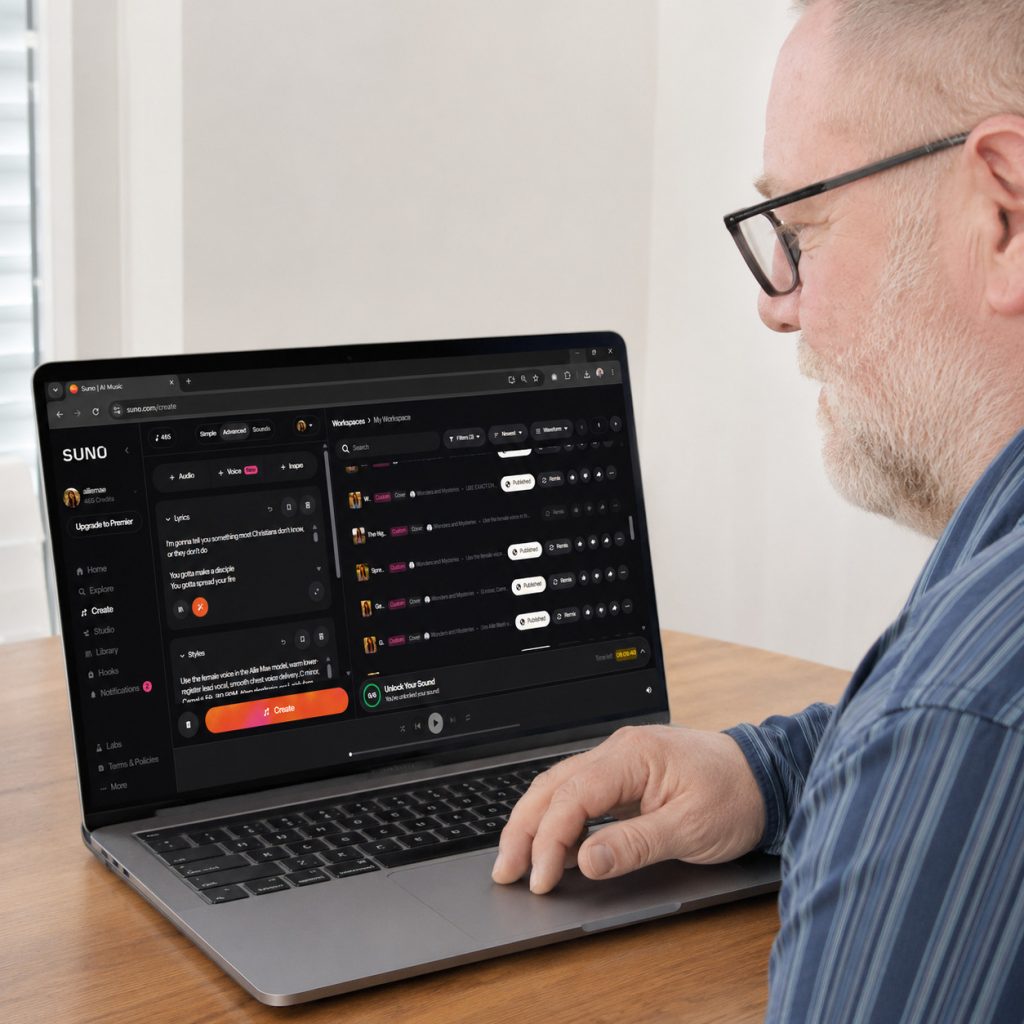
I cannot remember exactly how I stumbled onto Suno, or what I will call AI-assisted music production. I researched it for a little while because I did not really understand it.
But when I found out that you could upload your own music and make a model, and that you could restore, or at least make better, old recordings, that was it for me.
I knew I wanted to get into it.
Because I was laid up at my aunt’s house with a torn Achilles tendon, I got into Suno and started doing a few things. Then I paid for a subscription because I wanted the advanced tools.
At first, something strange was happening with the conversion rate. For a while, I thought I was going to have to pay around $450 a month to use Suno. So I hesitated.
Then I figured out it was converting to Mexican pesos, and it was only going to cost me about $10 a month.
So I signed up.
Of course, I made a model of my own voice.
I uploaded about twenty-four original four-track recorded demo songs of mine. These were songs I wrote, played, and sang myself. I used those songs to create my own model on Suno.
In the beginning, I picked one song I was really interested in and started working on what became the album Wonders and Mysteries. Those were the love songs I had written during the heartbreak years.
I started doing them with the model of my own voice.
And it was good.
It was really good.
After AI enhancement, my songs sounded like me playing, and they sounded like my real voice. It was like hearing my voice as though I had a million-dollar voice, like a professional singer. I was listening to professionally recorded, studio-level productions of my own music.
But something was wrong.
It was dull.
It was boring.
That was kind of a revelation to me.
I was going to do it anyway. I thought I would do all my songs that way, because now I would finally have music I could listen to and also pass to other people. I could say, “Here, if you like Christian music, here are some songs that I wrote.”
But the truth is, the only people who would probably listen to that material were people who knew it was me. I could maybe count them on two hands.
The songs were musically attractive, but the style was still strict acoustic folk music and voice. That is mostly what I had ever been able to do. I had never really had the heart to put my music to drums, keyboards, and other instruments.
That was the first revelation AI gave me.
It helped me hear that even if my own voice and guitar could be made to sound professional, the result was still not necessarily something that would reach people.
Then the second revelation happened.
I accidentally flipped the switch to female.
Everything changed.
It made me think back to Dusty Brown, where the young lady had sung some of the songs. Those songs resonated with me more when a female voice sang them.
The same thing happened here.
The female voice carried the songs better.
The songs opened up. The emotion came through differently. The tenderness worked better. The ache worked better. The songs felt more alive.
That was the beginning of Ailie Mae.
At first, I did not have a whole artist identity planned out. I did not sit down and decide to invent an AI-assisted Christian singer. I started with songs.
Old songs.
Real songs.
Songs that had been written across years of life, faith, heartbreak, longing, sadness, hope, obedience, and silence.
The songs came first.
Then the AI tool opened a door.
Then the female voice appeared almost by accident.
And that voice changed everything.
The female singing was still using the model of my own voice. Somehow, by some computer miracle, it sounded like me, but female. It did not sound like the other voices you hear on these platforms. It sounded like a female version of the tone and feeling that was already in my own songs.
Not only that, but she was singing my lyrics. In the background, the model was still carrying something from the guitar I had played on those old songs.
So it was transforming my style, my tone, my voice, and my guitar into a whole new thing.
That was strange and powerful to me.
I did not see it as pretending to be a woman. I did not see it as trying to deceive anybody. It was a production decision. It was a voice that carried the songs better.
In traditional music, that would not be strange. Songwriters write songs for other singers all the time. Producers find the voice that fits the song. A song can be written by one person and carried by another.
With AI, it feels strange at first because the singer is not a normal human singer.
But the musical decision was simple.
The voice worked.
And because the voice worked, Ailie Mae began to make sense.
I wanted the songs exactly the way I wanted them. Each song took many iterations. I probably went through twenty different versions of many songs until I got the prompts right.
In this platform, you can prompt things to happen with brackets. The AI understands that whatever is in the brackets is an instruction. You can tell it the style you want in one field, and then inside the lyrics you can also tell it what to do.
You can say stop here.
Drop to silence here.
Swelling voice.
Portamento.
Whispered.
Spoken.
You can guide the song through brackets.
That takes time to learn.
Over the process of going through all these trashed copies of songs that did not come out the way I wanted, I learned how to run the system. I also learned how to bring out the best of my words and my chord structures.
The voice began to take on a kind of personality.
As I learned how to use the system, I also learned how to bring in newer, more modern styles. There are electronic instruments and production styles that make the songs feel fresher and more modern. As that happened, Ailie Mae began to have a sound.
Then I had my AI assistant help develop images of Ailie Mae. I did not give a lot of detail at first. I just knew I wanted a young female image because the female voice had become part of the evolution of the music.
The images also began to give her a personality.
That was new to me.
It felt like a new art form.
Ailie Mae is not a real woman. I do not want to lie about that. She is an AI-assisted Christian artist. The songs are written, composed, and produced by me, David L. Markham.
But even though she is not a real person, the artist identity became real in another sense.
A project can have a voice.
A project can have a sound.
A project can have a visual identity.
A project can have a purpose.
That is what Ailie Mae became.
She became the voice and face of songs that had waited for decades.
The amazing thing is that the music kept getting better. The more I worked with the tool, the better I got at hearing what was wrong and what was right. I learned how to change the lyrics when they did not sing right. I learned how to change the style prompt. I learned how to ask for a lower register, a closer vocal, less reverb, more bass, or a different kind of beat.
I learned that a polished version is not always the right version.
Sometimes a version sounds expensive, but it does not tell the truth of the song.
So I had to listen.
I had to reject versions.
I had to keep working.
A song might take four, five, or six hours. Some took longer. Sometimes I burned through a lot of credits. But I was not just pushing a button.
I was producing.
I was listening for whether the song was true.
That is what all those years had prepared me for. The piano, the purple Hondo, the poetry, Hastings, the Stratocaster, the Tascam, the bands, the mixer, the 12-string, seminary, the cabin, Dusty Brown, the Roland studio, the long silence, and the boxes of tapes — all of that was still underneath this new thing.
AI did not erase that history.
It gave that history a new instrument.
That is how Ailie Mae came out of the old songs.
She came out of the tapes.
She came out of the demos.
She came out of the words I had written.
She came out of the guitar patterns and melodies I had carried for years.
She came out of the fact that I had not thrown everything away.
The old recordings were not finished records. They were not good enough for the world in the form they were in. But they were source material. They were the foundation.
And when AI music opened the door, those songs were ready to come back.
That is the strange thing about this whole story.
For years, I thought I was only preserving the past.
But I was actually preparing the future.
Ailie Mae is not human.
But the songs are human.
She did not live my life.
But she carries songs that came from my life.
She did not write the music.
But through her, the music can finally be heard.
That is why this matters.
The old music stopped being only mine in a private room.
It found a new voice.
Ailie Mae.
An AI-assisted Christian artist.
Original songs written, composed, and produced by David Lawrence Markham.
Ailie Mae is a voice that is not human, but is carrying songs that are.