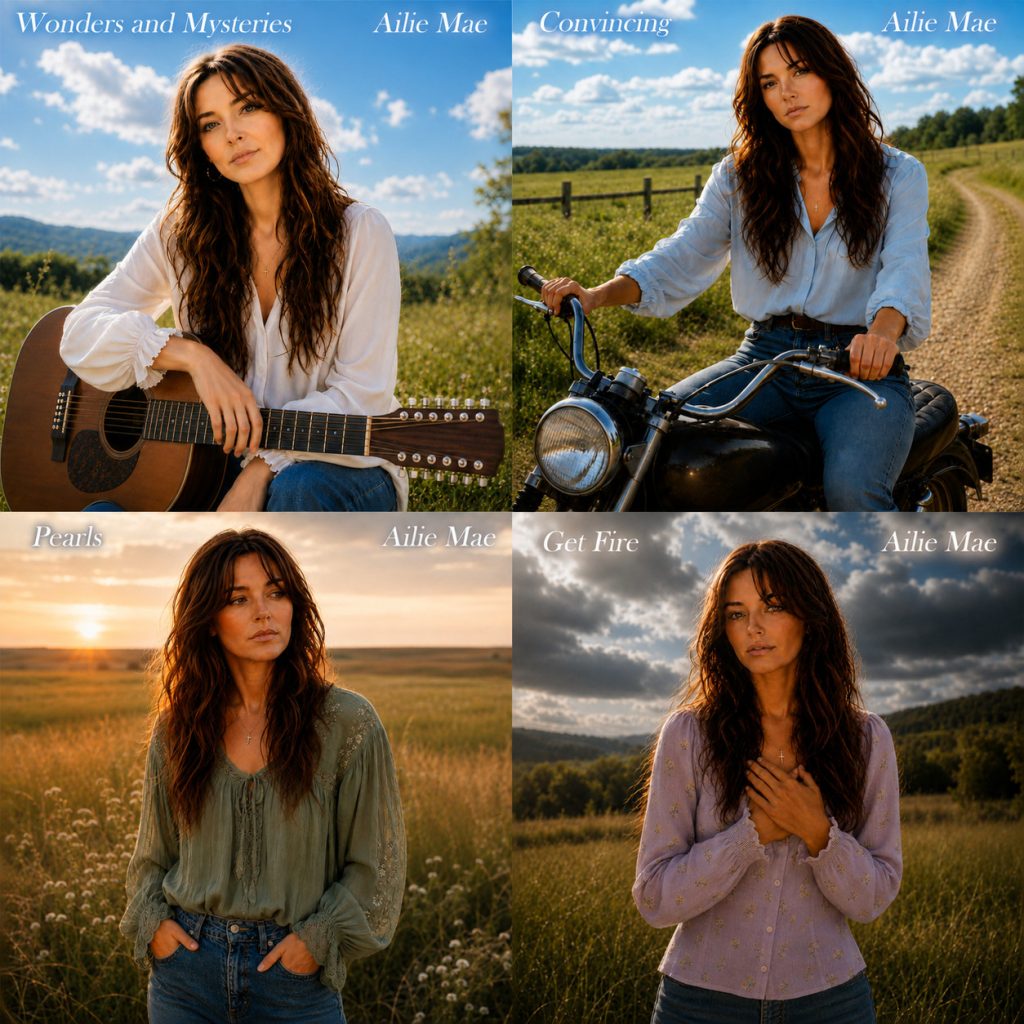
At first, I thought I was restoring music and I was making it better. The first album Wonders and Mysteries was fantastic. Ailie Mae and AI enhancement made my music listenable to many people, not just me and a handful of family and friends.
I had old songs new. I had made old cassette recordings listenable. I had taken old four-track demos to the next level. I had digitized the tapes and cleaned them up as much as I could and it paid off. The songs were there, but they were still not finished recordings in the way people expect music to sound today. But AI opened another door.
At the beginning, I thought I was only going to make my old songs sound better. I thought I was going to take the old guitar-and-voice recordings and enhance them, maybe make them sound like studio-level versions of what I had already done.
But as I kept working, something else happened.
The songs began to evolve. The AI was picking up on the heart of my music and giving it an elevated aspect.
They were no longer just old tapes being cleaned up. They were becoming something new.
My old songs were mostly acoustic guitar and voice. The first album represents my original style and music even though it is also evolved a bit. Other words could describe it as elevated and modernized.
Acoustic guitar and voice was what I had always been able to do. I would write the music first, usually on guitar, and then the lyrics would come later. Most of those songs were folk songs, or modern contemporary folk songs. That was just what came out of me.
I had never really had the heart to put drums, bass, keyboards, and other instruments around my music.
But AI started doing that.
It would add drums. It would add bass. It would add keyboards. It would add electronic instruments and textures. It would put movement under the songs. It would make them feel more modern.
That surprised me.
I had heard my songs one way for most of my life. I had heard them as guitar songs. But now I was hearing them with a fuller production around them. Some songs stayed close to the old feeling, but others began to move into a newer sound.
As the process continued, Ailie Mae did not remain only a folk or acoustic voice. She moved into modern production. There were contemporary Christian sounds, alternative folk sounds, electronic touches, dance, R&B, soul, deeper beats, and later the stronger modern Christian sound of the fourth album.
That mattered because the project was not only about restoring the past.
It was about carrying the past into the present.
I did not want to make museum music.
I wanted the songs to live.
But the tool did not just give me the right song. It gave me possibilities.
Most of those possibilities were wrong.
Some were close. Some sounded good but were not right. Some had one beautiful part and then something else ruined the song. Some had the wrong voice. Some had too much reverb. Some had the wrong beat. Some sang too high. Some sounded impressive but did not tell the truth of the song.
So I had to listen.
I began to learn which versions were merely impressive and which versions were true.
That is why the AI music process became more than a technical experiment.
It became a school.
A strange school, maybe, but a real one.
The old four-track had taught me to listen to my own performances. The Roland studio had taught me to build songs. The long silence had taught me what it costs to lay music down. The old cassettes had taught me that the heart of a song can survive rough conditions.
Now AI was teaching me production judgment in a new way.
The more I worked, the more I realized that production is not only playing instruments. It is not only knowing how to use a mixing board. It is not only arranging tracks in a studio.
Production is decision-making.
It is choosing what serves the song.
It is hearing what belongs and what does not.
It is knowing when something is beautiful but wrong.
It is knowing when to abandon a version and start again.
AI did not remove that responsibility.
It made me practice it over and over.
Sometimes I would go through dozens of versions of a song. Sometimes the lyrics would change during the process because the phrasing did not fit. Sometimes a line that looked good on paper did not sing well. Sometimes the AI would expose weakness in the lyric.
Sometimes it would find an emotional path I had not expected.
Sometimes it would make a producer-like decision that taught me something about the song.
That was another surprise.
The system had been trained on music. It had absorbed patterns of arrangement, structure, movement, and production. Sometimes it would leave space where I might have filled it. Sometimes it would shorten something I thought was necessary. Sometimes it would bring in a lift, a drop, a harmony, or a rhythmic change that made the song work better.
I did not accept those choices blindly.
But I listened to them.
And that listening changed me.
I began to understand my own songs better. I began to hear when a lyric needed to be simpler. I began to hear when the chorus needed more room. I began to hear when the emotional delivery mattered more than a clever line.
I also began to learn what I did not want.
I did not want Ailie Mae to sound like she was just showing off. I did not want exaggerated vocal runs. I did not want gospel shouting unless the song truly called for it. I did not want giant high notes that felt like performance instead of prayer. I did not want endless ad-libs. I did not want artificial la-la or da-da filler.
I wanted a natural voice.
I wanted a believable voice.
I wanted a voice that could sing Christian songs without sounding like it was trying to impress the church.
Sometimes that meant soft.
Sometimes that meant urgent.
Sometimes that meant lower and more controlled.
Sometimes that meant almost spoken.
The vocal had to serve the song.
That became one of my strongest rules.
Do not let the voice show off at the expense of the message.
The lyrics also changed as I worked.
A song might go through ten or fifteen revisions, and the words might change twenty percent before the finished version came. That was not the AI replacing the writing. That was me hearing the song more clearly because the process forced the lyric to prove itself in a real vocal shape.
That part was exciting.
It reminded me that songwriting is not only inspiration. It is shaping. It is cutting. It is listening. It is learning where the emotion really is and removing what gets in the way.
Ailie Mae became part of that refinement process.
Not as a human collaborator, but as the voice through which I could hear whether the song was alive.
And out of that, Ailie Mae grew.
Not all at once.
Not fully formed.
But through song after song, version after version, mistake after mistake, correction after correction, she began to have a sound.
Some songs carried more of the old demo feeling. Some had electronic touches. Some felt more melancholy, more like aged four-track memory. Some felt more modern. But all of them were part of the same larger resurrection of the songs.
Then the fourth album, Get Fire, began to become something else.
That album was more direct. More urgent. More openly Christian in an instructional way. It was not only reflective. It was speaking. It was calling. It was telling a new generation to get low, get fire, get into the fight, go into the darkness, worship Him, obey Him, and take the gospel where it has not gone.
That was a major shift.
It showed me that Ailie Mae was not only a way to rescue old songs. She could also carry new songs, new lyrics, new urgency, and new messages formed from the same life of faith but aimed forward.
That is when the project began to feel larger.
At the beginning, I thought I was restoring music.
Then I realized I was also producing new music.
And Ailie Mae was the vessel for both.
That is important because her existence is not only technical. She represents the point where my old music history, my mission field calling, my Christian faith, my long silence, my songwriting, and modern AI tools all collided.
That combination is unusual.
I know that.
It is not a normal artist story.
But it is my story.
Ailie Mae could not have existed when I was sixteen with the purple Hondo. She could not have existed when I was playing the Wurlitzer. She could not have existed in the Hastings listening room. She could not have existed with the four-track in seminary. She could not have existed in Dallas with Dusty Brown and the Roland studio.
But all of those chapters were necessary for her to exist.
Without the Hondo, I would not have become a songwriter.
Without the piano, I would not have learned to listen.
Without the listening room, I would not have learned emotional scale.
Without the four-track, I would not have learned to capture sound.
Without Dusty Brown, I would not have learned to build a world.
Without the long silence, the songs would not carry the weight they carry now.
Without the old cassettes, there would be no source material.
Without AI, there would be no way to bring it all forward at this scale.
AI did not make me a musician.
Music made me a musician.
Life made me a songwriter.
Faith gave the songs their deepest reason.
The old tapes preserved the evidence.
Ailie Mae gave the songs a voice.
And AI gave me a studio at the exact moment when the old songs were ready to live again.
That is why I kept going.
Because every once in a while, after many failed versions, something would happen. The vocal would sit right. The lyric would land. The beat would support the song. The arrangement would open up. The song would no longer feel like an experiment.
It would feel finished.
Those moments made the work worth it.
They made the rejected versions worth it.
They made the hours worth it.
They made the credits worth it.
They made me believe that the old songs had not only survived.
They had found a way to become new.