My best friend at the time was Clay Bowen. His father was Lloyd Clayton Bowen II. He had been the bass player for Jim Reeves and Mickey Gilley, who were two very famous country and western musicians. He had a big Fender bass locked away in his closet somewhere.
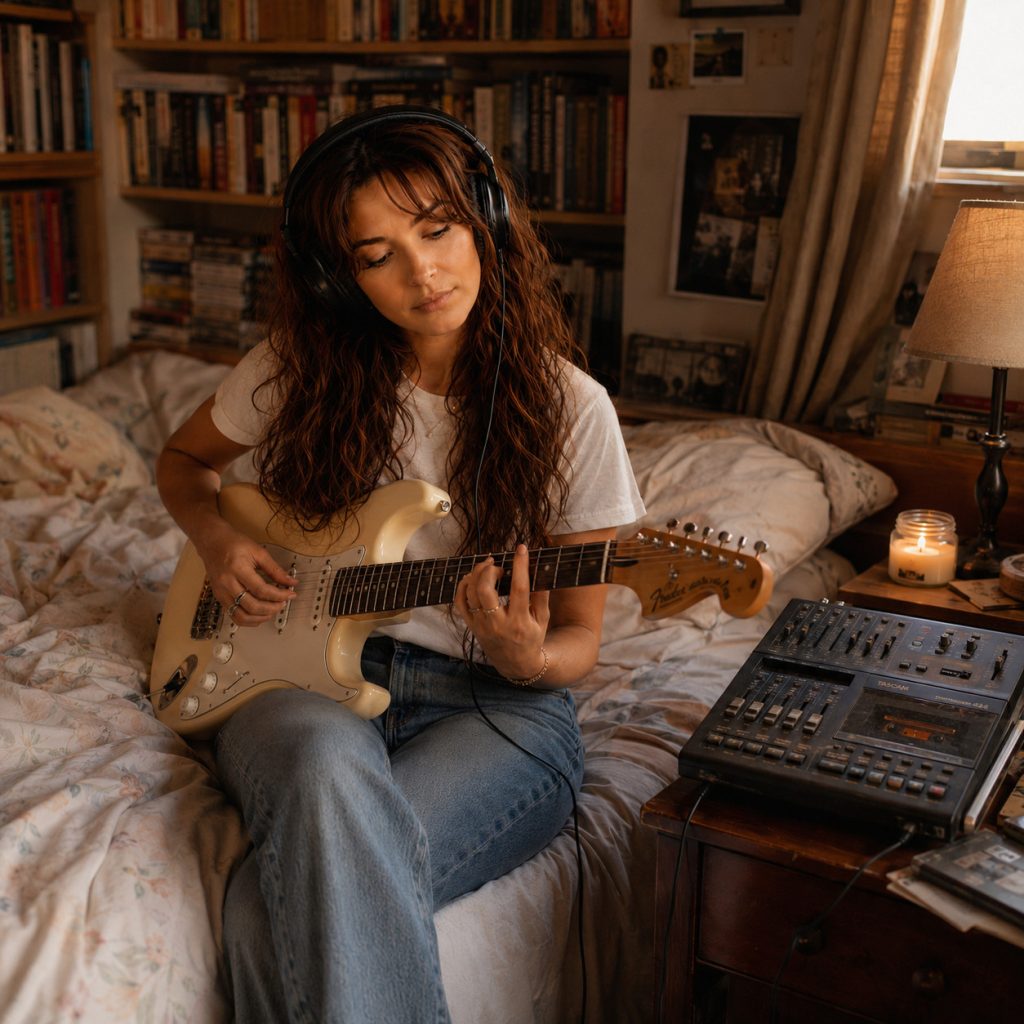
Near his chair in the living room, he had a short-neck Fender Stratocaster on a little stand.
Lloyd Clayton Bowen II was an older guy, and in that season of my life, he was kind of like a second father to me. That is a different story, but it matters here because I was around that house a lot.
He would come home from work, and we would all sit in the front room — me, him, and his son Clay. We would watch the evening news, and then we would watch MASH, which was an old seventies TV show.
While we were sitting there, he would play his short-neck Fender Stratocaster.
It was cream yellow, really nice, and a very high-quality electric guitar. It was kind of beat up and old, but boy, it was a beautiful guitar, and it played wonderfully.
At that time, I still had my old purple Hondo. It was getting beat up a little bit too, but I carried it with me everywhere. We would walk through parks, through alleys, and around with our friends. We walked everywhere, and I had that Hondo strapped over my shoulder, playing the guitar all the time.
But when Clay Bowen was not at home, I would sit in Lloyd’s chair and play his short-neck Fender Stratocaster.
That Stratocaster was different from my acoustic guitar. My purple Hondo made me press hard. The Stratocaster had another kind of sound. It played easier. It had a voice of its own.
All this time, I was writing poetry, playing guitar, and making up songs.
Then, back in Lloyd’s room, next to his bed, he had a Tascam four-track cassette recorder. The Portastudio I think it was called. It was a little four-track recording studio. It was just a little console with mixing buttons on it, and you put your cassette tape in it.
You could record one track, then record a second, a third, and a fourth. You could rewind the cassette and put another track on top of what you already recorded. That little tiny thin strip of tape actually held four tracks.
I do not know what drew me back into that room to sit down with it, but I did.
He never knew this, by the way. He never knew that I was in his room using his four-track recording studio.
I learned how to record on that four-track system and started recording my songs. I still have them on my tapes. They are my original songs that I recorded way back then.
He never knew any of this because he was at work, and I put everything back exactly the way it was.
He did allow me to borrow his short-neck Fender Stratocaster once. I asked him if he would lend it to me so I could play rock and roll music at a kid’s birthday party. I had started getting into rock bands and playing rock music because we liked it. It was fun, and we were kids. All pro rock musicians are just kids who never grew up.
We formed several bands. I was in several bands, and that is a whole other story.
I am not completely sure about this memory, but I think Lloyd went away on a trip somewhere, and I brought his four-track over to my room. We practiced in my room at my parents’ house. We had a band back then, and there was a girl singer in it. I think her name was Karen something.
I think I brought that four-track all the way over to my house because he was out of town, and we recorded on it.
But you know how kids are.
Looking back, that Tascam four-track was one of the first places where I learned that a song could be captured. It was not just something I played once and then forgot. It could be recorded. It could be layered. It could be played back.
A guitar could go on one track. A voice could go on another. Another part could go on another track. Suddenly, a song did not have to be only one performance in one moment.
It could be built.
It could be heard from the outside.
That changed something for me.
When you record yourself, you begin to hear what is really there. Sometimes that is encouraging, and sometimes it is humbling. The machine gives you back the truth. It shows you what worked, what did not work, and whether the feeling in the song actually came through.
I did not have a professional studio. I did not have expensive microphones. I did not have engineers or producers helping me. I had a purple Hondo, access to a Stratocaster, a friend’s house, and a Tascam four-track in the back room.
But that was enough to begin.
Those early recordings were not polished. They were not professional. They were just the first attempts to catch my own songs before they disappeared.
And that became part of the story.
The piano had taught me to listen. The Hondo had taught me to press through pain. The notebooks had turned into lyrics. The Hastings listening room and the used records had opened my ears to a bigger world of music.
Then Clay Bowen’s house gave me something else.
It gave me the sound of Lloyd playing Stratocaster in the living room.
And it gave me the first little recording studio where I began to learn how to capture my songs.