All these things were coming together: my writing, my music, learning how to play the guitar, and learning how to record.
The interesting thing is that through the years when I played rock music, I could never put my own words to rock and roll music. My songs were always folk songs, kind of modern contemporary folk music.
It was usually just me singing, a guitar track, maybe a second track of lead guitar, and maybe another part. When I wrote music, I wrote the music before I wrote the lyrics. That is just how it happened.
I would write the guitar song first, and it was acoustic. I could never really play an electric guitar with distortion and write music to it. I tried a few times, but it just was not in me to write rock music.
I have always listened to all kinds of styles of music. But even though I personally do not prefer to listen to acoustic folk music all the time, that is what came out of me.
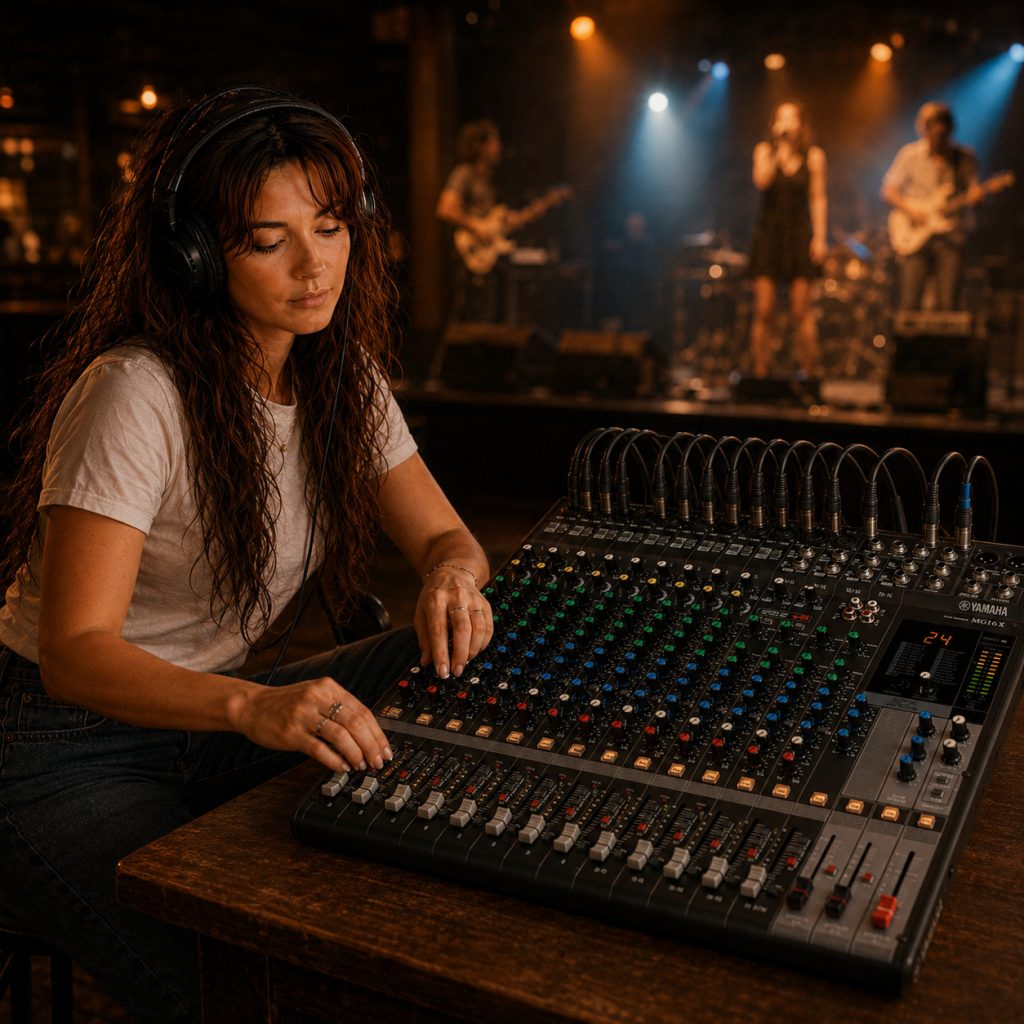
All these things were coming together, but there were also a lot of people around me who were more talented rock musicians. I eventually became the sound person in the bands.
I even spent the college fund that my mother and father had been saving for me. I spent it on an expensive mixer and some big concert speakers. Well, big for us. They were big enough for a kid band to play gigs and people’s parties.
We did not make much money at it, but I became the mixer. I became the sound person because I liked making the sound better through mixing.
That became part of the puzzle for me: listening, mixing, and getting the levels right.
When you learn mixing, or when you learn what the knobs do on a mixing console, or when you learn how to use a four-track recording studio, you learn what sounds good.
I think studio mixers use something called a reference track. They are listening to the production inside the studio while musicians are behind the glass playing live and being recorded. Then they have a reference track to remind them what really good mixed music sounds like.
So they may stop for a minute, put the headphones on, and listen to a highly produced mixed track to get their brains reoriented.
I did not have all of that, but I did learn what sounded good. I learned by being around sound, by turning knobs, by listening, and by trying to make a band sound better.
So I became the mixer in the rock bands. Basically, I was the sound person. The professional term is Front of House (FOH) engineer or live sound engineer.
Other people were the roadies. They moved the equipment around, plugged everything in, set up the speakers, set up the drum set, and got everything ready. I was the one getting the mix ready and making sure all the cables were connected into the rack.
That rack cost 2,400 I am remembering and had a compressor, and some other rack mounted thing, reverb, equalizer and some kind of sound amplifiers. All went out to two tall speakers with tweeters and monitors for the musicians.
I even mixed the band I was following at the time when they played in competitions.
That taught me something different from just playing guitar. When you play an instrument, you are responsible for your part. When you mix, you are responsible for the whole sound.
The vocal has to sit right. The guitars have to be heard but not hurt people. The bass has to have weight without becoming mud. The drums have to move the room without swallowing everything else.
The whole band has to become one sound.
I learned that by doing it.
A mixer teaches you that sound is made of balances. Too much of one thing and the whole song changes. Too little of another thing and the song loses its center. A vocal can be buried. A guitar can be too sharp. A bass can disappear or take over.
The wrong balance can make a good band sound bad. The right balance can make an ordinary band feel alive.
That was live production before I had language for production.
It taught me that music is not only the notes. It is the way the notes reach people. It is the room. It is the equipment. It is the mix. It is the decision to bring one thing forward and pull another thing back.
It is the judgment to know when louder is not better, when cleaner is better, when the vocal needs air, and when the band needs to come down so the song can come through.
Looking back now, I can see that the band room, the Tascam, the mixer, and the concert speakers were all part of the same education.
The Tascam taught me that songs could be layered.
The bands taught me that musicians have to listen to one another.
The mixer taught me that the whole sound matters.
The speakers taught me that music changes when it has to fill a room.
And live sound taught me that somebody has to make decisions for the song in real time.
That is why the later AI production did not come out of nowhere. When I was sitting with Suno decades later, rejecting one version, keeping another, asking for less reverb, more bass, a closer vocal, a lower register, a different beat, or a more believable emotional delivery, I was using ears that had been trained long before AI existed.
I had been listening from behind a board for years before I ever sat behind a laptop trying to produce Ailie Mae.
So when I say I was producing, that word does not begin with Suno.
It goes back to the Tascam in Lloyd’s room.
It goes back to band practice in my room.
It goes back to standing behind a mixer and trying to make a band sound right.
It goes back to the money I spent on that mixer and those big speakers.
It goes back to the first time I realized that the person controlling the sound can shape how a song is understood.
That was all part of becoming the sound person.
Chapter 6: Coming to Jesus Moment and Songs for Myself — The Story of Ailie Mae