Probably the only reason any of this would be relevant to someone is if my music became more popular.
After seminary, I went back to northern Texas and eventually moved to Dallas to work at a printing company. I worked in factories making books. A fluke happened at the factory where I got promoted, and I started to make more money.
This was a time when I was single. I was not back on the mission field yet, and I was going through kind of a lonely time in my life.
I had written a book-length poem called Dusty Brown, which is actually published on Amazon. Songs started to emerge from that. This was in the mid-1990s, after I had left seminary and had gotten back into the workplace.
I moved to Dallas to be around my family and take a job at a bigger company in northern Texas. I worked in printing companies there. I got into printing because in seminary they had taught me how to run machines in a book bindery.
So I was in Dallas, and I had money. The digital recording studio had finally come onto the scene. Tape was no longer needed in the same way.
About that time, I was at a music store. I went into the back room where they had all their acoustic guitars, and there were acoustic 12-string guitars hanging on the wall made by a company in Canada called Seagull.
There was this acoustic 12-string guitar hanging on the wall. I picked it up and strummed it, and I thought, “Oh my God, this sounds like my 1970-whatever Yamaha dreadnought 12-string.”
I do not know how they did it. They were handmade in Canada. Maybe the company is still in business. It was not very expensive either, which was the other surprise to me. It was maybe $350 or $400 for this really beautiful-sounding 12-string guitar.
The sound and quality of that guitar inspired me so much that I started to write songs to fit my book-length poem about rabbits, believe it or not.
The rabbits are really stories about people. There is this rabbit, and his name is Dusty Brown. Dusty Brown falls in love with Misty Hair, and Misty Hair lives in the same burrow he does. Dusty wants to take a trip and go away over the mountains, but she does not want to go with him.
That story became about fifteen songs that I recorded on a digital recording studio.
No tape hiss.
Those recordings satisfied my personal listening itch for a long time. If I ever wanted to hear a song or console myself in the Lord, I would listen to a CD or an MP3 of my songs from the album Dusty Brown. Listen to the Dusty Brown album on Spotify. Listen to Dusty Brown on iTunes. Get the book Dusty Brown on Amazon.
There were a couple of other little songs that never got onto the album, and some of those are on Spotify. I put Dusty Brown and a couple of songs that were not originally part of the Dusty Brown poem up on Spotify.
The idea was that you could buy the book on Amazon, read the poem, and where it tells you to stop and listen to a song, you would go out onto Spotify and listen to the song. That is kind of how it works.
I even went to a couple of publishers to try to get that poem published because I thought it was a really cool idea.
But after hearing what AI can do with my music, those recordings are not very professional. They are the best recordings I ever made, and they are the best thing I ever produced before Ailie Mae, but they are nowhere near what a professionally mixed recording would be.
The mix is not bad. I did it in a quiet room with a digital recording studio that, I believe, had unlimited tracks, though I think it had eight tracks on the board.
I also had digital tape to make tapes. It was a special kind of cassette tape. It probably does not exist anymore. It was called DAT tape.
I did all of this recording in my apartment when I lived in Dallas and worked at the printing company.
That recording studio was expensive. Even though I made good money, it was not easy to get it. It was around $2,800 back in 1996, I believe, somewhere around that time.
I think it took me about a year to do that recording.
One thing I need to mention is that the project needed a female person to sing some of the songs. Some of the songs were Misty Hair songs, singing back to Dusty Brown.
So I put an ad in the paper. It said something like, “Local folk artist needs female singer,” on the chance that she might get royalties one day. I wanted to publish it and make money from it too, because I thought it was that good.
Someone answered the ad.
She was a really nice girl. She had a boyfriend. We never had any relationship whatsoever. Her boyfriend would bring her over and drop her off at my apartment. I would give her a cassette tape demo to take home and practice. When she came back the next session, she would sing her part into the digital recording studio.
She has several songs on the Dusty Brown album on Spotify.
Those were my favorite songs, the ones she sang. She had a voice.
My voice is not bad, but my voice is not a professional recording voice, not for making money, and not the kind of voice most people want to listen to. But she had that voice.
I got really lucky in the Lord with her, because those were the songs that meant something to me after I got done with that recording.
Dusty Brown became the biggest creative project of that part of my life. It was a book-length poem, a set of songs, a recording project, and a world.
It was not perfect. It was not famous. It was not finished the way a major studio would have finished it. But it was real.
There were recordings. There were songs. There was a book. There was a world that had come out of me and taken form.
That mattered.
A lot of creative work never gets that far. It stays in notebooks. It stays in memory. It stays in little fragments. Dusty Brown got past “someday.” It became something.
Then I got the opportunity to leave my fancy job in Dallas and go back to the mission field.
After making money, moving up the corporate ladder, and recording my long list of songs from the poem Dusty Brown, I went back to the mission field to my missionary pastors that I had originally gone to back in the 1980s.
I asked my pastor, “Do you think I ought to bring this digital recording studio? I would really like to do it.”
And he said no.
So I got rid of it.
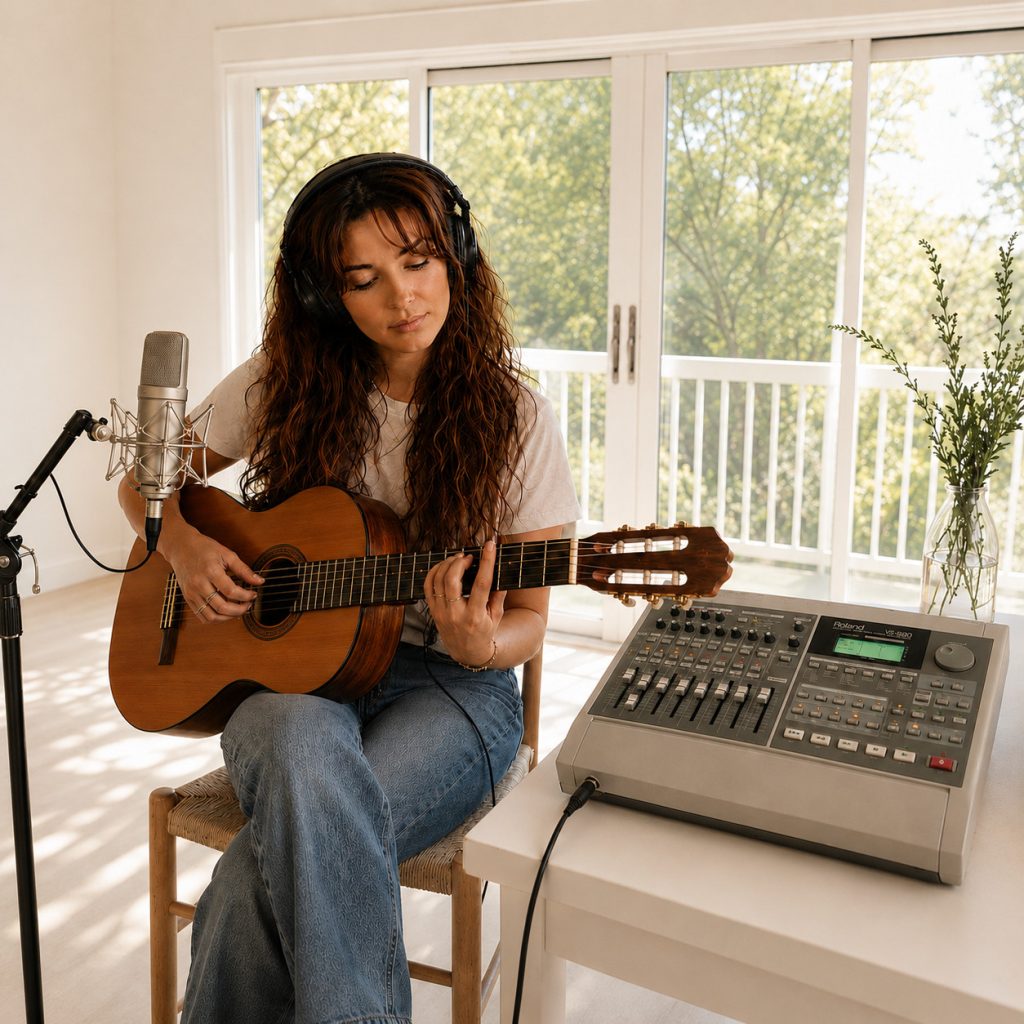
It was a Roland. I do not remember the exact kind it was, but it looked like a little mixing console with knobs on it. It was kind of cream-colored. You could get an extension that had a digital CD burner for it, and you could buy an extension for its memory and stuff like that.
It was kind of archaic, but once you learned how to use it, it worked.
Today we have computerized digital audio workstations, so we do not need those old devices. Even professional studios use software like Pro Tools now. I have used BandLab by SoundLabs, which is a digital audio workstation.
But back then, that Roland was my studio.
After I wrote the last song for Dusty Brown, I do not believe I wrote any more complete songs for a long time, because I went back to the mission field and I was too busy.
I have picked up a guitar through the years, and there are three or four pieces of music that I keep playing. They keep getting better, but they do not really have lyrics yet.
One summer, we had a bunch of missionary candidates, and they put lyrics to one of those pieces. They heard me sitting around playing guitar, and someone said, “Hey, let’s put words to that.” They put it up on YouTube as a missionary song.
But those are not the lyrics that go with that piece of music.
So, after the Dusty Brown digital workstation era — 1996, 1997, maybe 1998 — I went back to the mission field in 1998.
That was the end of that recording chapter.
Dusty Brown was not the end of my music story, but it was the high point of my pre-AI recording life. It was the season of Dallas, printing, the Seagull 12-string, the Roland VS-880 studio, DAT tapes, the female Misty Hair parts, and the dream of making a complete world out of words and music.
Then the studio was gone.
The recordings were packed away.
The mission field became the road again.
And the songs waited.
Read Chapter 9: Digitization of Boxes of Tapes During the Pandemic of 2020